

PRIORITY Project
Project name: PRIORITY - Prioritising novel genomic and chemical space via federated learning and pre-clinical development
Funder: Netherlands Organisation for Scientific Research (NWO), the Dutch Research Council’s Knowledge and Innovation Covenant Antimicrobial Resistance (KIC-AMR) programme
Budget: €1.4 million
Duration: 5 years (September 2025 – August 2030)
Partners: 9 partners from 6 countries
Coordinator: Leiden University, the Netherlands
The overall goal of this project is to find new antibiotic compounds and improve existing ones by using artificial intelligence (AI) and advanced scientific tools. These discoveries will help create the next generation of antibiotics needed to fight drug-resistant infections. We also want to ensure that any new medicines developed from this work can be made available worldwide, including in lower-income countries, not just wealthier nations.
The Challenge
Antibiotic discovery has only explored a fraction of nature's potential
Actinomycetes have produced the majority of clinically used antibiotics, yet a large proportion of their biosynthetic potential remains unexplored. PRIORITY is designed to find this hidden chemical space by combining artificial intelligence, genomic and metabolomic data, synthetic biology and bioactivity screening.
Scientific Concept
Learning from data without moving the data
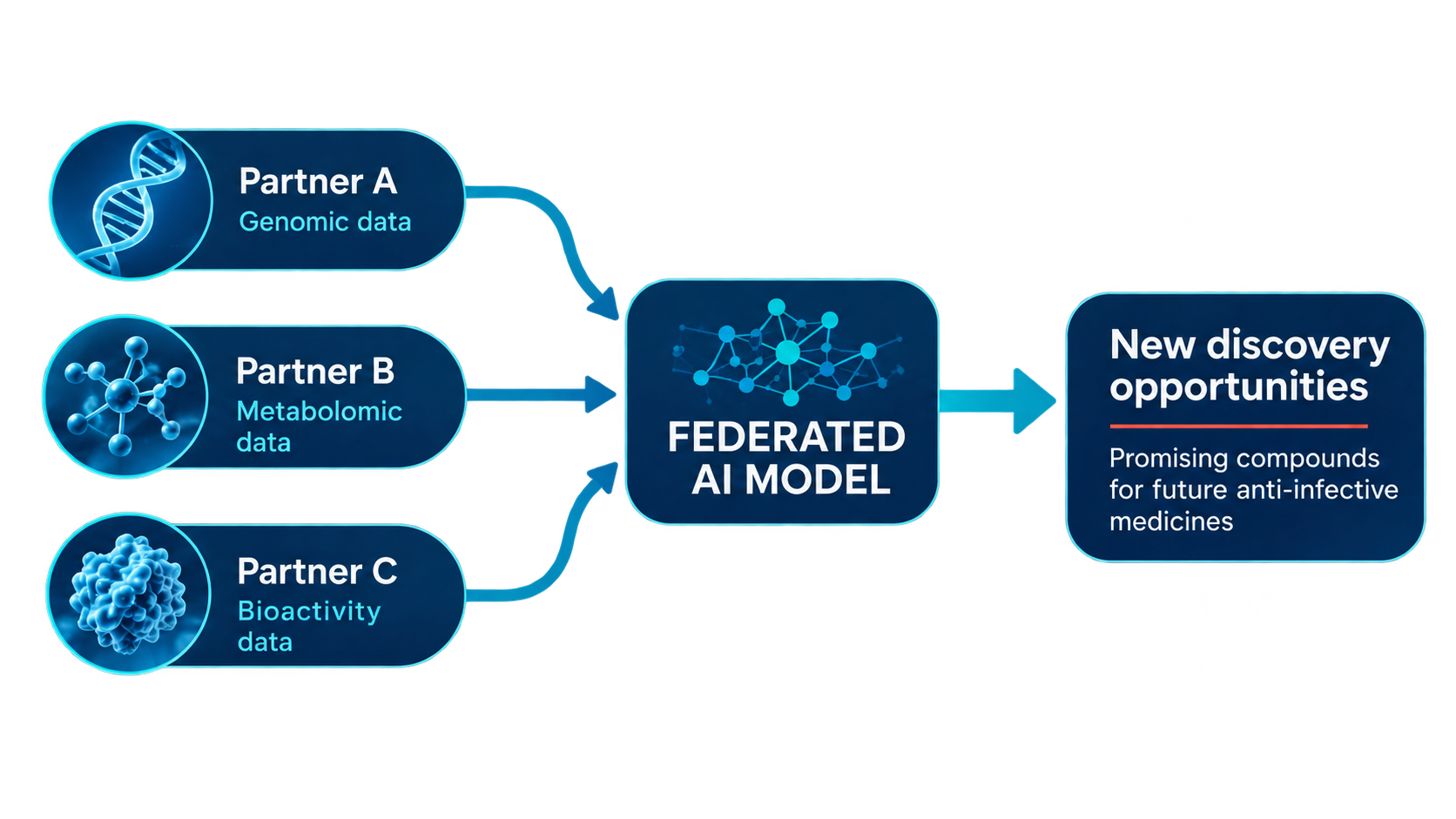
PRIORITY uses federated learning, an AI approach that allows models to learn from data held by different organisations without requiring those datasets to be brought together in one place. This means partners can contribute knowledge from taxonomic, genomic, metabolomic and bioactivity datasets (300,000+ actinomycete strains, millions of biosynthetic gene clusters) while preserving data ownership and intellectual property.
THE C4D MEMBERS
Global expertise, connected through one discovery platform
Gilles van Wezel (Coordinator), Leiden University, Netherlands
Marnix Medema, Wageningen University, Netherlands
Meta Roestenberg, Leiden University Medical Center, Netherlands
Joleen Masschelein, KU Leuven & VIB, Belgium
Alan Hennessy, GARDP, Geneva, Switzerland
Olga Genilloud, Fundación MEDINA, Granada, Spain
Stefano Donadio and Marianne Lorio, NAICONS, Milan, Italy
Nigel Mouncey, Joint Genome Institute, Berkeley, USA
Ben Shen, University of Florida, USA
The project brings together complementary expertise across natural product discovery, microbiology, genomics, metabolomics, AI and pre-clinical development. By combining access to extensive actinomycete strain collections with advanced data analysis and collaborative research, the team is uniquely positioned to identify promising biosynthetic pathways, prioritise novel chemical scaffolds and advance promising antibiotic candidates. Through federated learning, partners can generate insights from diverse datasets while retaining control of their underlying data and intellectual property. The AI-driven discovery platform developed through the project will be made publicly available, helping to accelerate antibiotic discovery and support further research beyond the project.
The C4D team is combining:
Federated learning and AI: Connecting and learning from distributed datasets across partner organisations without requiring sensitive data to be brought together, while safeguarding data ownership and intellectual property.
Genomic and metabolomic analysis: Exploring actinomycete genomes and their associated metabolites to identify biosynthetic gene clusters and uncover previously unexplored chemical space.
Large-scale bioactivity screening: Drawing on extensive actinomycete strain collections and biological screening to identify compounds with promising antibiotic activity.
Data-driven prioritisation and preclinical development: Prioritising promising leads based on chemical novelty, biological activity and predicted drug properties, with selected candidates progressing towards preclinical evaluation.
Expected Results
Discover new chemical scaffolds: Find molecules that conventional discovery approaches may overlook.
Improve promising candidates: Advance new and existing hits towards improved efficacy and drug-like properties.
Connect global datasets: Enable researchers to learn from complementary datasets without centralising sensitive data.
Accelerate discovery worldwide: Make the resulting AI platform publicly available to support future antibiotic research.
Contact
Coordinator: Gilles van Wezel (Leiden University) g.wezel@biology.leidenuniv.nl